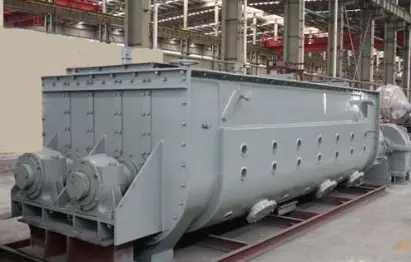
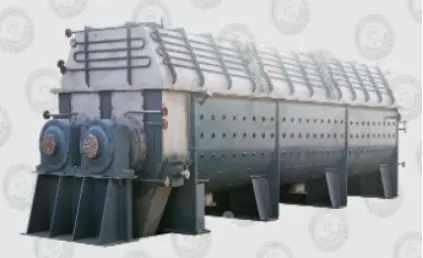
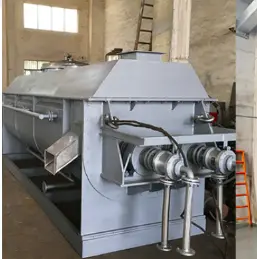
Hollow blade puddle dryer
The blade dryer has been successfully applied in fields such as food, chemical, petrochemical, dye, and industrial sludge.The equipment's characteristics of heat transfer, cooling, and stirring enable it to complete the following unit operations: drying, cooling, heating, reaction, sterilization, etc.The stirring blade is also a heat transfer surface, which increases the heat transfer area within the unit's effective volume and shortens the processing time.
 ■ With thermal oil or hot air, steam as the heat medium, the drying function can be accomplished.
■ By introducing cooling media such as water, cooling brine, etc., it can be used for cooling.
■ Within the axial range, the uniformity of temperature, humidity, and mixing degree enables the equipment to be used for heating or melting, or for some solid material reactions.It has been successfully used in the compound fertilizer and modified starch industries. The blade dryer can be used for sterilization treatment of food and flour.The large heating area within the unit's effective volume quickly heats the material to the sterilization temperature, avoiding the change in material quality due to prolonged heating.
Main features
■ The blade dryer has low energy consumption: Due to indirect heating, a large amount of air is not used to carry away heat, and an insulation layer is set on the outer wall of the dryer.
■ The blade dryer system has low cost: With a huge heat transfer surface within the unit's effective volume, it shortens the processing time, and the equipment size becomes smaller.
This results in reduced building area and space requirements.
■ Wide range of material handling: Using different heat media, it can handle both heat-sensitive materials and those requiring high-temperature treatment.
Commonly used media include: steam, heat transfer oil, hot water, cooling water, etc. It can operate continuously or intermittently and can be applied in many fields.
■ Low environmental pollution: No air is carried, and the amount of dust-laden material is very small. The evaporation amount of the material solvent is very small, making it easy to handle.
For materials with pollution or situations requiring solvent recovery, a closed-loop circulation can be adopted.
■ Low operating costs: During normal operation, only 1-2 people are needed per day. Low-speed stirring and reasonable structure. The wear is small, and the maintenance cost is very low.
■ Stable operation: Due to the special compression-expansion stirring effect of the wedge-shaped blades, the material particles are fully in contact with the heat transfer surface.
Within the axial range, the temperature, humidity, and mixing degree gradient of the material is very small, thus ensuring the stability of the process.
Applicable materials:
Environmental protection industry: PTA sludge, electroplating wastewater sludge, boiler ash, pharmaceutical factory waste residue, sugar factory waste residue,monosodium glutamate factory waste residue, coal ash, domestic sludge, etc.
Feed industry: Soy sauce residue, bone-based feed, alcohol residue, food waste scraps, apple residue, orange peel, soybean meal, chicken bone feed, fish meal, feed additives, biological sludge and mud
Food industry: Starch, cocoa beans, corn kernels, salt, modified starch, medicine.
Chemical industry: Sodium carbonate, nitrogen-phosphorus-kiln fertilizer, kaolin, bentonite, white carbon black, carbon black, phosphogypsum, fluorosilicic acid sodium,calcium nitrate, magnesium carbonate, aluminum hydroxide, barium sulfate, calcium sulfate, calcium carbonate, dyes, molecular sieves, saponin.
Contact us
Fixed line: +86-379-65195189
Mobile/Wechat/Whatsapp: 13838843223
Email: info@lykzhb.cn/ sales@lykzhb.cn
Company address:501/502,Building No. 1, Zone B,Luoyang University Science and Technology Park, Luoyang City, Henan Province, China.
Factory address: No. 18, Fuxin Rd, Luoxin Industry Park, Luoyang City, Henan Province, China
Fixed line: +86-379-65195189
Mobile/Wechat/Whatsapp: 13838843223
Email: info@lykzhb.cn/ sales@lykzhb.cn
Company address:501/502,Building No. 1, Zone B,Luoyang University Science and Technology Park, Luoyang City, Henan Province, China.
Factory address: No. 18, Fuxin Rd, Luoxin Industry Park, Luoyang City, Henan Province, China
Copyright © 2024 Luoyang Kaizheng environmental protection processing equipment Co., LTD